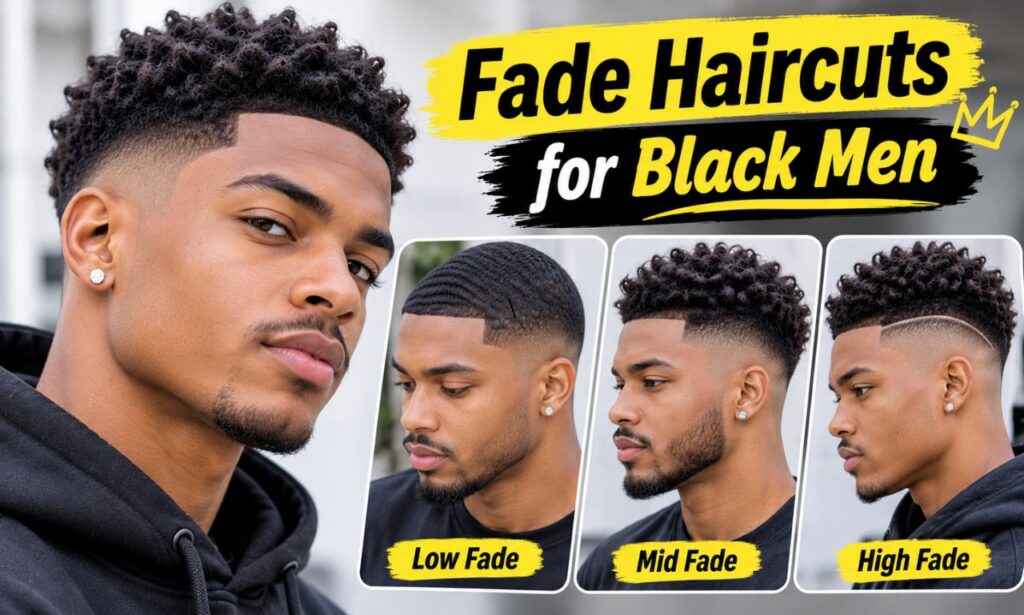
A fresh fade can change how you look in under an hour. The sides get sharp, the top gets shape, and your natural texture finally looks intentional.Choosing one is harder than it looks. Names like drop, burst, taper and skin get tossed around, and they do not always mean the same thing in every shop. This guide explains each style in plain language. It also shows you how to match a fade to your hair texture, hairline and lifestyle.
Fade Haircuts for Black Men: Start With Placement
Placement is where the fade begins on your head. Most people skip this step and go straight to a photo. That is why they often walk out with a cut that looks different from what they pictured.
A fade is a gradual change in length. The hair is longest on top and shortens smoothly toward the neckline and around the ears. A taper is a lighter version. It shortens only at the sideburns and nape and leaves more length elsewhere.
There are three main placements:
- Low fade: The blend starts near the ear and the lower edge of the hairline. It is subtle and office friendly.
- Mid fade: The blend starts around the temple level. It balances contrast and softness.
- High fade: The blend starts above the temples, near the upper head. It creates the strongest contrast.
Think of placement as the height of the fade, not the style itself. Pick the height first. Then choose the shape, the top and the depth.
Types of Fades and Tapers for Black Men: 6 Popular Options
Compare your preferences first
Before you scroll through photos, answer three questions:
- How bold do you want to look? Low placements read calm. High placements read sharp.
- How much time do you spend styling? Waves and sponge curls need daily effort. A short afro needs very little.
- What does your workplace expect? Many offices accept a low taper. A high skin fade may feel too edgy for some.
Your hair texture matters too. Tight coils hold sharp lines well. Looser curls need a barber who understands how they spring back after cutting.
Low taper with waves
This is the quiet classic. The taper stays small around the sideburns and neckline, while the top is cut short and brushed into wave patterns.
Best for: Men who want a clean, professional look with minimal contrast.
Why it works: The sides barely change, so the waves stay the focus. It also grows out gracefully.
Tip: Brush daily with a medium or hard brush and wear a durag at night. Waves train over time, not overnight.
Temple fade with curls or a short afro
A temple fade, also called a temp fade, focuses on the temples and the sideburn area. The rest of the sides stay a bit longer. Pair it with defined curls or a rounded short afro.
Best for: Men who like volume but want crisp edges.
Why it works: The tight cleanup frames the face without removing too much length.
Tip: Use a curl cream on damp hair, then pick out the shape gently. A good lineup keeps the style looking sharp.
Burst fade with coils, faux hawk or mohawk
A burst fade curves around the ear in a semicircle. The hair behind it stays longer, which creates a bold shape that suits texture on top.
Best for: Men who want a modern, high-energy cut.
Why it works: The curve highlights coils and adds shape from the side and the back.
Tip: For a faux hawk, keep the top tight in the center. Use a light pomade to hold the peak.
Drop fade with twists
The drop fade follows the curve of your head and dips lower behind the ear. This arc adds interest from the side and back.
Best for: Men with twists, short locs or curly tops who want a clear shape.
Why it works: The dropped line balances heavier hair on top and makes the cut look designed.
Tip: Twists need regular retwisting. Plan your barber visit around that schedule so the fade stays fresh.
Mid fade with a compact coily top
This is the balanced option. The fade starts at mid height, and the top stays short and defined.
Best for: Men who want flexibility. You can dress it up for work or down for the weekend.
Why it works: It offers more contrast than a low fade but less drama than a high fade.
Tip: A thin shape-up along the front hairline makes this cut look polished with very little styling.
High taper with a fuller top
A high taper starts the shortening high on the sides. It still leaves a bit more length than a full fade. Pair it with a taller natural top.
Best for: Men who want height and presence.
Why it works: The clean sides make a fuller top look neat, not messy.
Tip: Moisturize the top every day. Fuller hair dries out faster and can look dull without care.
More Fade Haircuts for Black Men, With Photos
Use these as a visual shortlist. When you add photos to your own page, write specific alt text such as “low fade with 360 waves on a Black man.” It helps accessibility and image search.
Low fade with 360 waves
Waves ripple around the entire head. The low fade keeps the sides neat while the pattern stays visible from every angle. This style takes patience and a consistent brush routine.
Caesar cut with a low fade
The Caesar cut features short, even length on top and a small horizontal fringe. With a low fade, it looks tidy and timeless. It is one of the easiest cuts to maintain.
Skin fade with sponge curls
The sides go down to the skin, and the top is twisted into small sponge curls. The contrast is strong and the texture stands out. Expect to return to the barber often to keep the skin look clean.
Low drop fade
This is a softer version of the drop fade. The line curves low behind the ear and keeps the overall look subtle. It works well for men who want shape without high contrast.
High top fade
The sides are faded close while the top stays tall and boxed or rounded. It has strong retro roots and still feels current. Keep the shape even with regular trims.
Fade with a beard
The fade blends into the beard at the sideburns. A smooth transition makes the whole face look balanced. Ask your barber to match the beard’s lower fade with the hair fade so there is no sudden jump.
Low fade with a curly top
Soft curls rest on top while the sides stay clean. This look is relaxed and friendly. Use a light leave-in conditioner to keep the curls springy.
Fade for older men
A low or mid taper with a neat top is a safe and sharp choice. Keeping the sides short and the top slightly longer can look polished at any age. Gray hair looks especially clean with a crisp edge.
Fade with a hard part
A hard part is a razored line cut into the hair on the side. It adds a sharp detail to any fade. Ask for a part that follows your natural growth direction so it grows out well.
Mid Fade From the Front, Side and Back
The mid fade is popular because it looks good from every angle. Here is what to check in the chair:
- Front: The hairline should be even on both sides. The temples should look balanced, not one higher than the other.
- Side: The blend should climb smoothly with no visible steps or patches. Watch the area just above the ear.
- Back: The neckline should follow your natural shape or be squared off. Both are fine. The key is a clean, symmetrical finish.
If you can see a hard line between short and long hair, the blend needs more work. Ask your barber to soften it.
Choose Shadow, Zero or Skin Separately
Placement is only half the decision. The depth of the fade is separate.
- Shadow fade: The hair is cut very short, but not to the skin. It leaves a soft shadow. It is a good starting point if you are new to fades.
- Zero fade: The clippers run with no guard, so the sides are close but may show slight stubble. It looks clean with a small amount of softness.
- Skin fade: Also called a bald fade. A foil shaver or razor takes the hair down to the skin at the lowest point. It gives the highest contrast and needs the most upkeep.
Many men ask for a “high skin fade” when they really want a mid shadow fade. Decide on both placement and depth to avoid surprises.
Natural Hairline Guidance for Fade Haircuts for Black Men
Your hairline is part of the design. A good barber works with it, not against it.
- Respect your natural shape. Some hairlines are straight. Others have a soft curve or a widow’s peak. Forcing a square line can make the face look unbalanced.
- Do not chase a perfect line every week. Over-shaving the hairline can irritate the skin and thin the edges over time.
- Watch for razor bumps. Curly hair can curl back into the skin after close shaving. This can cause irritation known as pseudofolliculitis barbae. The American Academy of Dermatology offers guidance on prevention, such as shaving with the grain and avoiding very close passes.
- Handle receding edges carefully. A slightly softer line can look more natural and hide thinning better than a sharp, low edge.
If your skin is sensitive, tell your barber before the cut. Ask for a lighter pass on the neckline and a soothing aftershave without heavy alcohol.
Match the Top to Your Real Texture
The top should suit the hair you actually have, not the hair in a photo. Here is a quick guide:
- Tight coils (4C): Great for short afros, sponge curls and high tops. They hold shape and volume well.
- Defined curls (4A to 4B): Good for curl cream styles, twists and taper fades with rounder tops.
- Looser curls or soft waves: Work nicely with 360 waves, Caesar cuts and combed tops.
- Thinning or fine hair: Keep the top shorter. A fade with a cropped textured top can look fuller than a long, thin one.
A realistic example: if you have tightly coiled hair, a long, flat, brushed-over top will fight your texture. A compact top with a clean fade works with it.
Exact Barber Request
Clear words get better results. Use this simple script and adjust it to your preference:
- Placement: “I would like a mid fade,” or low or high.
- Depth: “Start at a shadow,” or zero or skin.
- Shape: “Keep the fade curved and soft,” or “Drop it behind the ear.”
- Top length: “Leave about one to two inches on top,” or specify with your fingers.
- Lineup: “A natural lineup, not too sharp,” or “Crisp edges, please.”
- Beard: “Blend the fade into my beard,” if needed.
Bring one or two photos, but explain what you like about them. A photo shows the result. Your words explain the details.
A good barber will also ask about your routine. Answer honestly. If you only brush your hair for five minutes a day, say so.
Maintenance Without a Universal Schedule
No single schedule fits everyone. Hair grows at different speeds, and each fade depth shows regrowth at a different pace.
Use these guidelines, not rules:
- Skin fades show growth fastest. Many men revisit the barber every one to two weeks.
- Shadow and zero fades often look good for two to three weeks.
- Low tapers can last a bit longer because the changes are subtle.
Between visits, keep these habits:
- Moisturize your scalp and hair daily.
- Wear a satin or silk cap or a durag at night.
- Use a soft brush for waves, and a wide-tooth comb or pick for curls and afros.
- Wash with a gentle, moisturizing shampoo.
- Avoid heavy products that build up.
If edges begin to look rough or your top feels dry, those are signs to book. Let your own hair guide the timing.
Conclusion
The best fade is the one that fits your hair, hairline and routine. Start with placement, then choose depth, shape and top. Use the barber script above so your request is clear.
Be patient with your own texture. Sponge curls, waves and high tops all work, but each one needs a bit of care. Find a barber who listens and understands your hair, and the rest gets easier.
Sources and Further Reading
- American Academy of Dermatology: guidance on razor bumps and shaving for curly hair
- A licensed barber or cosmetologist in your area for personalized advice on your hairline and texture
- Barbering education resources and state licensing boards for standards on professional haircutting
Frequently Asked Questions
What is the best fade for Black men?
A low or mid fade suits most men because it balances contrast and looks clean on many face shapes. Your texture and style choice decide the final pick.
What is the difference between a taper and a fade?
A taper shortens hair only at the sideburns and nape. A fade blends much more hair, often down to the skin.
Which fade is best for waves?
A low fade with a short top works well, because it keeps the wave pattern visible. Consistent brushing matters most.
How often should I get a fade touch-up?
It depends on fade depth and hair growth. Skin fades often need a visit every one to two weeks, while softer fades can last longer.
Is a skin fade or shadow fade better for sensitive skin?
A shadow fade is gentler because it does not shave to the skin. Tell your barber about any irritation or razor bumps.

Abu Bakar is a passionate hairstyle and grooming writer who loves sharing the latest haircut trends, styling ideas, and hair care tips. He creates simple and helpful content for readers of goskyip.com to stay confident and stylish every day.