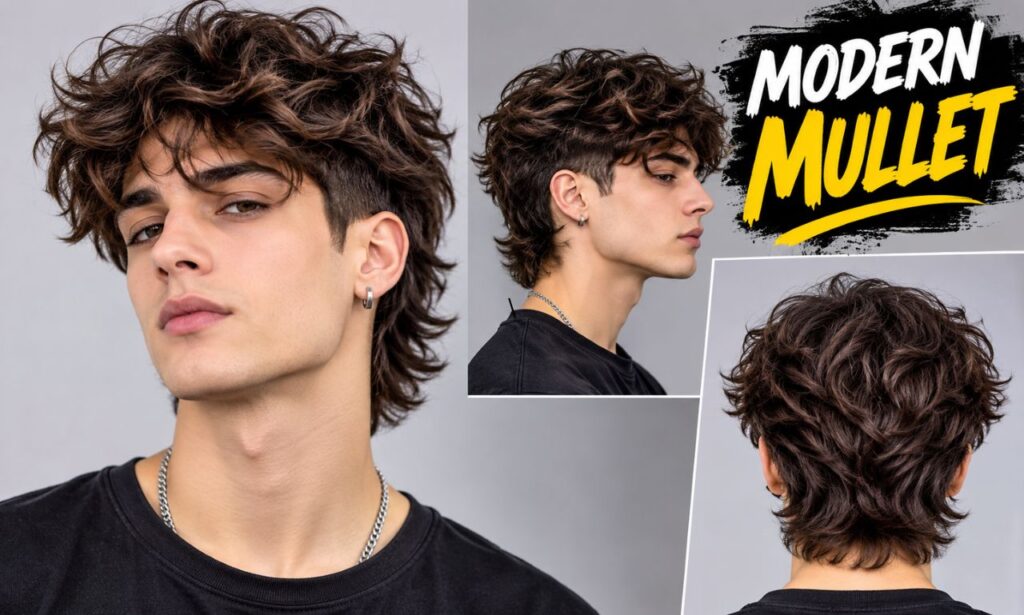
The mullet is back, but it is not the 1980s version. Today’s cut is cleaner, softer, and easier to wear to work, the gym, or a night out. A good modern mullet blends a tidy fade or taper with length at the back, so it looks planned rather than accidental.
Every mullet is short at the front and sides and long at the back. What makes it modern is the blend. The classic mullet had one-length sides and a hard jump to the long back. The hard part is not growing it. The hard part is explaining it to a barber. This guide covers the main fade options, how to choose a length, which version suits your hair type, how to grow one out, and the exact words to use in the chair.
What Is a Modern Mullet?
A modern mullet is a haircut with shorter hair on the top and sides and longer hair at the back. The old rule was “business in the front, party in the back.” The updated version keeps that idea but adds shaping, blending, and texture.
The main differences from the classic cut are:
- Sides are usually tapered or faded instead of left bulky
- The top has layers, so it flows into the back
- The length at the back is controlled, not stringy
- Styling products add texture rather than grease
Modern mullet at a glance
| Feature | Typical range |
| Top length | 2 to 5 inches (5 to 12 cm) |
| Sides | Skin fade to scissor taper |
| Back length | Nape to shoulder |
| Best hair types | Straight, wavy, curly, thick |
| Cut frequency | Every 4 to 6 weeks |
| Styling time | 3 to 5 minutes |
| Skill level to maintain | Low to medium |
A good rule of thumb: the sides set how sharp the cut looks, and the back sets how bold it looks. You can dial each one up or down independently.
Modern Mullet Fade Options
The fade is what separates a polished mullet from a messy one. It cleans up the sides and makes the longer back stand out on purpose. Here are the most popular options and who they suit.
Compare your preferences first
Before you pick a fade, ask yourself three questions:
- How sharp do I want the sides? Skin fades look crisp. Tapers look softer.
- How much upkeep will I accept? Sharper fades need touch-ups every 2 to 3 weeks.
- Where do I need to look neat? Office dress codes often suit a taper better than a high fade.
If you are unsure, start with the softest option and go shorter next time. Hair grows back. A bad fade does not undo itself.
Low taper mullet
The low taper starts the fade just above the ear and around the neckline. It is the safest and most professional choice.
Why people choose it:
- Looks neat without being aggressive
- Grows out gracefully
- Works for most face shapes
Best for: first-time mullet wearers, office jobs, and anyone who wants a subtle look.
Burst fade mullet
A burst fade curves around the ear in a semicircle, then fades down toward the neckline. The back is left long, which creates a strong contrast between the faded edges and the mullet length.
Why people choose it:
- Frames the ear and highlights the back length
- Looks sharp on curly and textured hair
- Adds shape without removing the top
Best for: people who want a statement cut with clean edges. It needs trimming every 3 weeks to keep the curve crisp.
Drop fade mullet
A drop fade follows the curve of the head, dropping lower behind the ear. This lets the fade sit behind the ear and sweeps into the nape, so the mullet length looks like it grows out of the fade.
Why people choose it:
- Gives a more dramatic, athletic look
- Pairs well with a textured crop on top
- Shows off the shape of the skull
Best for: short to medium mullets with a bold finish.
Mohawk mullet
Also called a mohawk fade mullet or “mullet hawk,” this style keeps length down the center and fades the sides tightly. The back runs long, and the top is often styled upward.
Why people choose it:
- High contrast and high impact
- Works well with thick hair
- Easy to style with clay or paste
Best for: confident dressers, creative fields, and events. Be ready for frequent maintenance.
Soft mullet with no fade
Not every modern mullet needs a fade. A soft mullet uses scissor cutting and layers to blend the sides into the back. The result looks relaxed and natural.
Why people choose it:
- Low maintenance
- Great for growing out
- Suits wavy and straight hair
Best for: people who want a lived-in look and fewer barber visits.
Short vs Long Modern Mullet
Length changes the personality of the cut. Here is how the two compare.
Short modern mullet
- Back length sits at the nape or just below the collar
- Easier to style and less likely to look dated
- Works well for work settings
- Fits people with thinner hair or small cowlicks at the crown
Long modern mullet
- Back reaches the shoulders or beyond
- Needs more product and more regular conditioning
- Looks bolder and more expressive
- Takes 8 to 12 months to grow from a standard cut
If you are not sure, go for a medium length. It gives you enough hair to style and enough room to adjust later.
Modern Mullet by Hair Type
Your hair texture decides how the cut behaves. A mullet that looks perfect on a friend may sit very differently on your head.
Curly mullet
Curls and mullets work beautifully together. The natural volume gives the top shape and the back falls in defined curls.
Tips:
- Ask for a burst fade or low taper to keep the sides tidy
- Do not let the barber thin out curls with razors
- Use a curl cream on damp hair and air dry or diffuse
- Keep the back slightly longer than you think you need, since curls spring up
Straight hair mullet
Straight hair shows every line in the cut, so precision matters. It can look sleek and sharp or soft and shaggy.
Tips:
- Ask for layers on the top to avoid a flat, helmet look
- Use sea salt spray or texturizing powder for grip
- Scissor over comb work helps blend the sides cleanly
- Choose a longer back if your hair is fine, since it adds visual weight
Wavy hair and the middle part mullet
Wavy hair is arguably the easiest to work with. It holds shape naturally and adds movement without much effort. The middle part mullet is especially popular here, with the hair split evenly down the center and falling to each side.
Tips:
- Use a lightweight cream or mousse
- Let the waves dry naturally for a softer finish
- Keep the part clean by combing it when damp
- A face with strong cheekbones suits the middle part most
Thick hair
Thick hair gives the mullet body, but it can also become bulky at the back and sides.
Tips:
- Ask for internal layering or removal of weight, not thinning shears across the whole head
- A tighter fade on the sides prevents a mushroom shape
- Use a strong paste or clay to control volume
- Wash with a moisturizing shampoo, since thick hair can feel dry
More Modern Mullet Styles to Ask For
If you want a variation, these are worth showing your barber:
- Short mullet with textured fringe: a cropped top with a soft fringe and a small tail at the back
- Shaggy mullet: heavy layers on the crown and a loose, rounded back
- Mullet with curtain bangs: the front splits to the sides and frames the face
- Business mullet: short top, low taper, and a tidy back that sits above the collar
- Permed mullet: a body wave or perm adds curl to straight hair
- Braided mullet: the back is braided or twisted for events or creative looks
- Mullet with color: bleached tips, a single highlight, or a natural brown with subtle gloss
Bring two or three reference photos. Pictures remove most of the guesswork.
Modern Mullet vs Wolf Cut
People often confuse the two, and they do overlap. The key difference is where the shape comes from.
| Modern mullet | Wolf cut | |
| Main shape | Short sides, longer back | Layered all over |
| Sides | Often faded or tapered | Usually left longer and shaggy |
| Layers | Focused on the top and crown | Heavy, choppy layers throughout |
| Overall vibe | Defined and structured | Messy and voluminous |
| Maintenance | Regular fade touch-ups | Fewer visits, more styling |
Think of the wolf cut as a mullet and a shag combined. If you want clean sides, ask for a mullet. If you want a loose, rock-style shape, ask for a wolf cut.
How to Grow a Mullet
Growing a mullet is mostly about patience and planning. Most people need 6 to 12 months to reach a comfortable length.
- Start with a clean base. Get a shape-up so the sides and neckline look tidy while the rest grows.
- Let the top and back grow. Aim for at least 3 to 4 inches on top and 4 to 6 inches at the back.
- Trim only the sides. Ask for a taper or light fade every 4 to 6 weeks.
- Fix the awkward phase. Around month 3 to 5, hair can look puffy or uneven. Use a hat, texture spray, or a slight middle part.
- Condition regularly. Longer hair breaks more easily, so use conditioner and avoid very hot water.
- Add layers when ready. Once length is enough, a barber can shape and blend the cut.
Hair grows about half an inch per month on average. Diet, genetics, and scalp health all affect speed, so do not compare your timeline with someone else’s.
What to Tell Your Barber
Clear instructions get better results. Use this simple script:
- Name the style: “I want a modern mullet.”
- Describe the sides: “A low taper” or “a burst fade, number 1 at the shortest.”
- Give the top length: “About three inches, with texture.”
- Give the back length: “To the bottom of my collar” or “just above the shoulders.”
- Mention blending: “Blend the sides into the back, not a hard line.”
- Share a photo. Show your reference, and point out what you like about it.
- State your routine: “I style for five minutes with paste.”
Useful questions to ask in return:
- How often will I need a trim to keep this shape?
- Will this work with my cowlick or hairline?
- What products would you recommend for my hair?
A good barber will adjust the plan to suit your head shape and hair density, so listen to their advice too.
Styling and Maintenance
A modern mullet looks best when it has movement and texture. Here is a quick routine.
Daily styling:
- Start with damp hair, not soaking wet.
- Apply sea salt spray or a light cream to the roots.
- Blow dry the top upward and the back downward.
- Finish with a pea-sized amount of clay or paste.
- Use your fingers to shape the ends.
Maintenance schedule:
- Fade or taper touch-up: every 2 to 4 weeks
- Full trim: every 4 to 6 weeks
- Deep conditioner: once a week for long or dry hair
- Shampoo: 2 to 3 times a week, depending on scalp oil
Product guide:
- Fine hair: texturizing powder or light mousse
- Thick hair: strong clay or paste
- Curly hair: curl cream or gel
- Wavy hair: sea salt spray
Common Modern Mullet Mistakes
Avoid these and your cut will look far better:
- Going too long too fast. A big back with no shape looks messy. Increase length gradually.
- Skipping the fade or taper. Bulky sides make the cut look dated.
- Using too much product. Heavy gel or wax can make the mullet look greasy.
- Ignoring hair type. Straight hair needs layers, and curly hair needs moisture.
- Not trimming the neckline. A clean nape keeps a long back looking intentional.
- Skipping regular cuts. Split ends and uneven layers ruin the shape quickly.
- Copying a photo exactly. Hair density, head shape, and hairline all change the result.
Frequently Asked Questions
What is a modern mullet?
A modern mullet is a haircut with short, faded or tapered sides and longer hair at the back, blended with layers on top.
How long does hair need to be for a mullet?
You need about 3 to 4 inches on top and at least 4 inches at the back, which usually takes 6 to 12 months.
What fade goes best with a mullet?
A low taper is the safest choice, while burst and drop fades work best for a bolder look.
Is a mullet good for curly hair?
Yes, curls add natural volume and texture, especially with a burst fade and a curl cream.
How often should I cut a modern mullet?
Trim every 4 to 6 weeks, and refresh fades every 2 to 4 weeks if you keep them sharp.
What is the difference between a mullet and a wolf cut?
A mullet has shorter sides and a longer back, while a wolf cut has heavy layers all over with a shaggier shape.
Conclusion
The modern mullet works because it is flexible. You can keep it short and professional, go long and expressive, or choose a fade that matches your style. The right version depends on your hair type, your lifestyle, and how much time you want to spend on upkeep.
Start with the fade you feel comfortable with, bring clear reference photos, and describe the length you want at the top and back. Then book regular trims to keep the shape sharp. With the right cut and a simple routine, a modern mullet is one of the most stylish and practical haircuts you can wear.

Abu Bakar is a passionate hairstyle and grooming writer who loves sharing the latest haircut trends, styling ideas, and hair care tips. He creates simple and helpful content for readers of goskyip.com to stay confident and stylish every day.