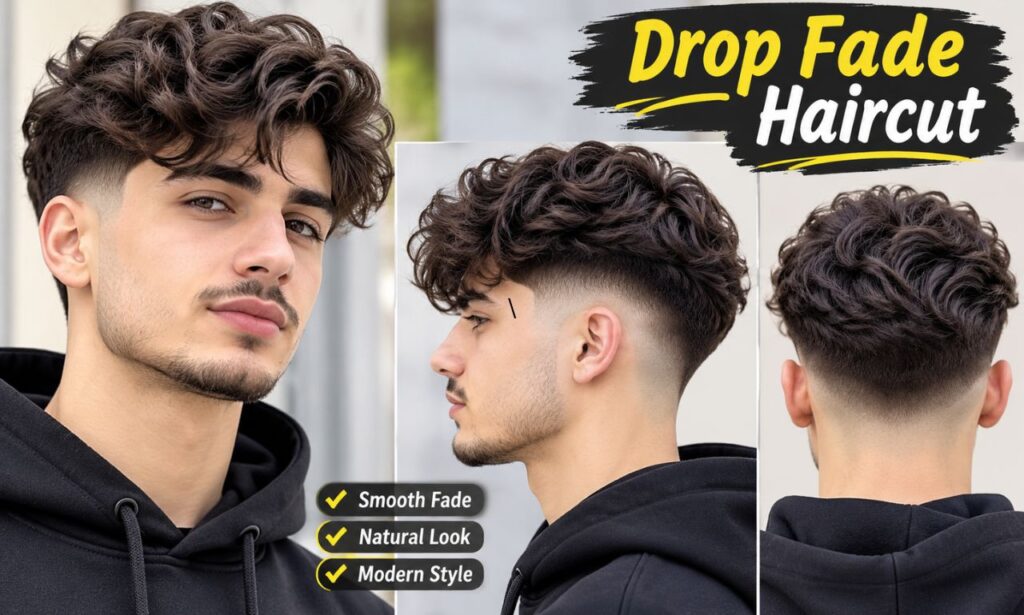
The drop fade is one of the most requested men’s haircuts right now. It looks sharp from the front, but its real character shows from the side and the back.
A drop fade haircut curves downward behind the ear instead of running in a flat line around the head. That small change adds shape, frames the skull, and makes almost any top look more finished.
This guide covers what the cut is, how it compares with other fades, how to choose your height and skin level, and how to pair it with your hair type. You will also get a word-for-word script to use in the chair.
Drop fade haircut gallery: side paths and rear contours
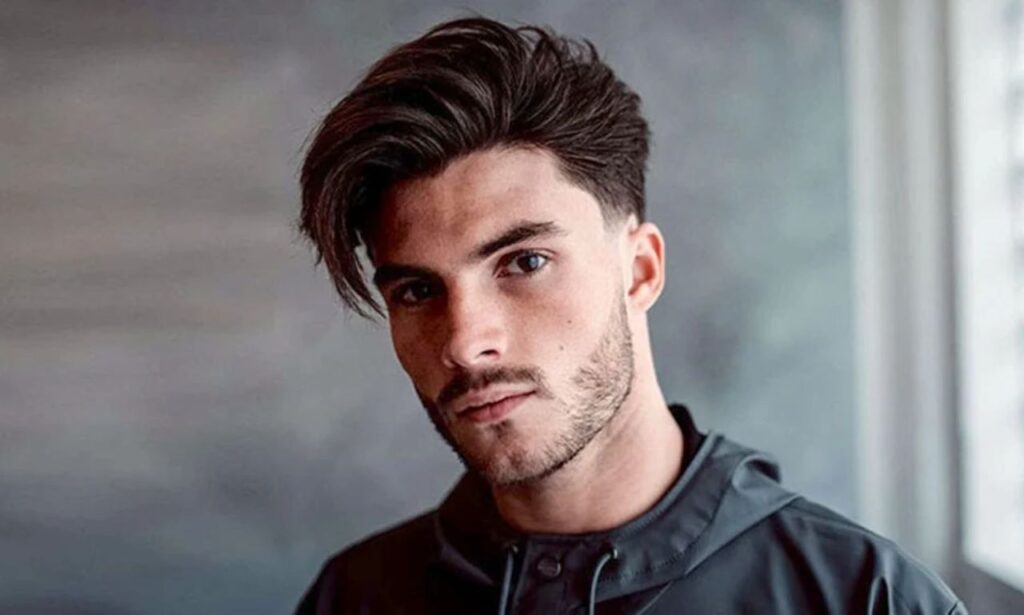
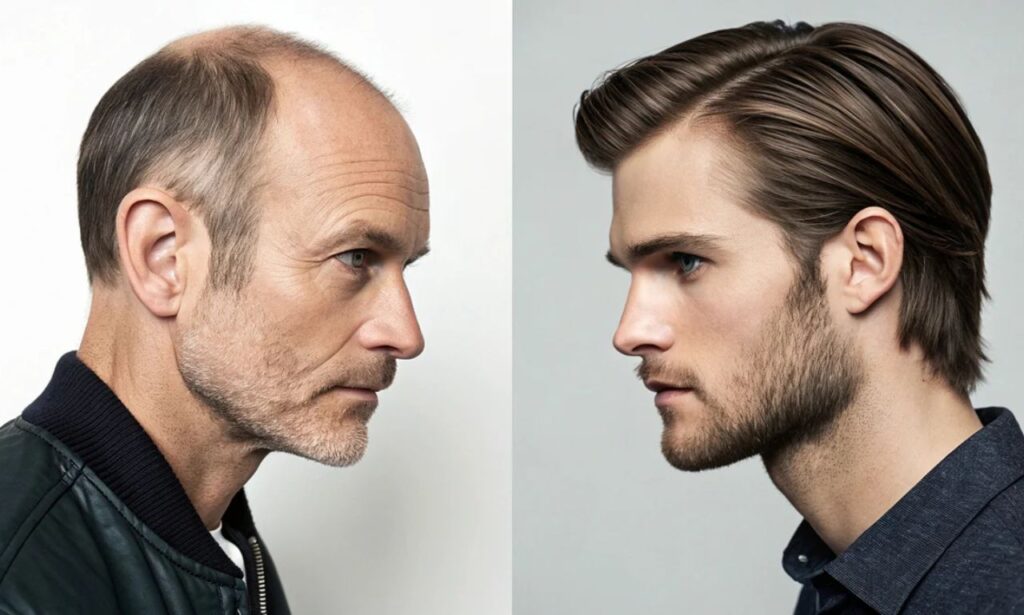
Photos are the fastest way to explain a haircut, but most people look at the wrong angle. They save the front view and forget that the drop fade lives on the sides and back.
When you collect reference photos, save these four views:
- Front three-quarter view. Shows the temple height and how the fade meets the top.
- Side profile. Shows the fade path as it rises over the ear.
- Behind-the-ear view. Shows where the line starts to curve down.
- Rear view. Shows the nape shape and how far the drop travels.
Here is what to look for in each type of photo:
- Low drop fade photos: The fade stays near the ear and dips quietly toward the neck. Common in office-friendly cuts.
- Mid drop fade photos: The curve starts around the temple. This is the balanced option and the one most barbers recommend first.
- High drop fade photos: The line starts near the crown level at the sides. It looks bold and contrasts strongly with the top.
- Skin drop fade photos: The shortest section reaches bare skin, which makes the curve very easy to see.
A good gallery shows the same haircut from several angles. If a photo only shows the front, ask your barber what the back looks like before you commit.
What Makes a Fade a “Drop”?
A fade becomes a “drop” when the fade line bends down behind the ear. A standard fade usually keeps a straight, level path around the head. The drop fade follows the curve of the skull and sinks toward the nape.
In simple terms:
- The fade starts higher at the temple.
- It arcs around the ear.
- It drops lower at the back of the head.
This curve works with the natural shape of your head. It also leaves more length at the front and sides and less at the nape, which gives a clean, tapered finish.
Compare your preferences first
Before you choose a version, answer these questions. They save time in the chair.
- How short do you want the sides at the shortest point?
- Do you want a visible curve, or a subtle one?
- How much length do you want to keep on top?
- Do you wear a beard or stubble?
- How often will you realistically visit the barber?
If you want a quiet, professional look, lean toward a low drop with a longer blend. If you want contrast and attitude, lean toward a mid or high drop with a tighter finish.
Drop Fade vs Standard Fade vs Burst Fade
These three fades get confused often. They are not the same cut.
| Feature | Standard Fade | Drop Fade | Burst Fade |
|---|---|---|---|
| Fade line | Straight and level | Curves down behind the ear | Semi-circle around the ear |
| Back of the head | Usually cut straight across | Longer at the nape, shaped by the curve | Left longer, often for a mullet or mohawk |
| Visual effect | Clean and uniform | Contoured and dimensional | Dramatic and rounded |
| Best for | Classic cuts | Most tops and head shapes | Mullets, mohawks, curly tops |
The short version:
- A standard fade is the simple baseline.
- A drop fade follows the skull and adds shape at the rear.
- A burst fade wraps around the ear and leaves hair longer at the back, so it suits tops with a lot of length.
A drop fade is also not the same as a taper. A taper trims the hair gradually and usually stays longer at the neckline. A fade goes shorter, often down to skin.
Low, Mid or High Drop Fade?
Height controls how bold the cut looks. Choose based on your face, your job, and how much contrast you want.
Low drop fade
- Starts just above the ear.
- Subtle and easy to grow out.
- Works well with beards, office dress codes, and thinner hair.
Mid drop fade
- Starts around the temple.
- The most balanced version.
- Suits most face shapes and almost every top.
High drop fade
- Starts high on the sides.
- Creates strong contrast and a sharp look.
- Works best on thicker hair and well-defined head shapes.
If you have never had a drop fade, start with mid. You can always go higher next time, but you cannot add hair back.
A few guidelines on face shape:
- Round face: A mid or high drop adds vertical lines and sharpens the profile.
- Long face: A low drop avoids adding more height.
- Square face: Any height works, since the curve softens the jaw.
- Narrow head: Keep the sides fuller with a low or mid drop.
Shadow, Zero or Skin Drop Fade?
The height of the fade is only half the choice. The other half is how short the shortest section goes.
- Shadow drop fade: The shortest area stays a shade above bare skin. It looks soft and works well for thinner hair or sensitive scalps.
- Zero drop fade: Cut with the clipper at zero. Very short, but not shaved smooth.
- Skin (bald) drop fade: A foil shaver or razor takes the shortest part to bare skin. It gives the strongest contrast and highlights the curve most clearly.
Skin fades look great fresh, but they show regrowth quickly. Expect to rebook sooner. A shadow fade ages more gracefully if you plan to stretch your visits.
Drop Fade Haircut Styles for Different Tops
The fade is only the foundation. What sits on top changes the whole feel.
Textured Crop, Fringe or Crew Cut
- Textured crop: Short, choppy layers pushed forward. A mid drop keeps it modern and low effort.
- Fringe: A forward-swept front paired with a low or mid drop looks relaxed and youthful.
- Crew cut: A classic short top with a drop fade adds a subtle twist to a conservative cut.
These styles need little product. A matte paste or sea salt spray is usually enough.
Curly or Coily Top
Curls and coils pair well with a drop fade because the sharp sides frame the texture on top.
- Keep the top at least two to three inches so the curl pattern shows.
- Use a mid or high drop for definition.
- A skin finish gives strong contrast against dense curls.
- Moisturize the top, since curly hair dries out more easily.
For tighter coils, ask your barber to shape the line gently so the curve does not look too hard against the texture.
Wavy Quiff or Longer Top
A wavy quiff or longer top uses the drop fade to keep the sides tidy.
- Choose a low or mid drop so the sides do not look too stark.
- Leave enough length to style upward or back.
- Use a light cream or pomade for hold without stiffness.
The fade controls bulk on the sides, which stops longer hair from looking heavy.
Pompadour, Faux Hawk or Mullet
These bolder styles gain the most from the curved shape.
- Pompadour: A high or mid drop sharpens the volume above it.
- Faux hawk: The drop fade narrows the sides and pushes attention to the center strip.
- Mullet: The drop fade (or a burst variation) leaves the back longer while keeping the sides short and clean.
With any of these, plan the back shape with your barber in advance, because the nape detail is what makes the cut look intentional.
How Texture and Density Change the Drop
Two people can ask for the same haircut and get different results. Hair texture and density are the reason.
Straight hair
- Shows the fade clearly.
- Blends smoothly, but flaws in the transition are easy to spot.
Wavy hair
- Hides small blending issues.
- Needs enough length on top for waves to form.
Curly and coily hair
- Holds the shape of the curve very well.
- Barbers often use a lineup or edge-up to define the front.
Thin or low-density hair
- Works best with a low or shadow drop.
- A high skin fade can expose scalp and make hair look thinner.
Thick or high-density hair
- Takes a mid or high drop very well.
- Needs more frequent trims because the contrast fades quickly.
Cowlicks matter too. A cowlick at the crown or nape can change how the fade lays. A good barber works with the growth pattern instead of fighting it.
Rear Shape, Nape and Beard Connection
This is the part most guides skip, and it is where a drop fade is judged.
Nape shape options
- Tapered nape: The hair fades naturally into the neck. Softer and more forgiving as it grows.
- Squared nape: A hard, straight edge. Looks very sharp but grows out unevenly.
- Rounded nape: A gentle curve that follows the neck. A good middle choice.
Ask which one your barber plans to use. A tapered or rounded nape works best with a drop fade, because it continues the same curve.
Connecting to a beard
- The fade should blend into the sideburn and then into the beard with no visible gap.
- On a full beard, the fade often runs into the beard line at the cheek.
- On stubble, a shadow fade makes the blend almost invisible.
Check the rear with a mirror. Before you leave, look at the back with a hand mirror. The curve should look even on both sides and the shortest area should sit at the same height on each side.
How to Ask Your Barber for a Drop Fade
Many bad haircuts come from unclear instructions. Use a short script and show photos.
A simple script you can copy:
“I’d like a mid drop fade. Start the fade at the temple, curve it behind the ear, and drop it toward the nape. Take the shortest part to a shadow (or skin). Keep about three inches on top, textured, and leave the front long enough to style forward. Blend the sideburn into my beard and round the neckline.”
Quick checklist for your consultation:
- Name the height: low, mid, or high.
- Name the finish: shadow, zero, or skin.
- Say how much length stays on top.
- Mention the nape shape: tapered, rounded, or squared.
- Show front, side, and back photos.
- Ask them to start longer. They can always take more off.
Helpful phrases if you are unsure:
- “Can you show me where the line will start before you cut?”
- “Can we go slightly longer on the first pass?”
- “I want it blended, not blocky.”
Good barbers like clear instructions. They also notice details like cowlicks and head shape, so listen if they suggest a small change.
Maintenance and Grow-Out
A drop fade looks best fresh, but the speed of regrowth depends on how short you went.
Typical rebooking timeline
- Skin fade: Every 2 to 3 weeks.
- Shadow or zero fade: Every 3 to 4 weeks.
- Low drop with a longer blend: Every 4 to 5 weeks.
Individual hair growth varies, so treat these as general guides rather than rules.
At-home care
- Wash and condition regularly to keep the scalp healthy.
- Use a light product on top, and avoid heavy gels that look greasy.
- Moisturize the skin on the sides, especially after a skin fade.
- Do not self-trim the fade line. Mistakes show immediately.
Growing it out
- Ask for a low drop on your next visit to soften the contrast.
- Move to a taper after that.
- Keep the nape tidy while the sides lengthen.
- Expect an awkward stage around week 6 to 8 and use a bit of product to manage it.
Patience helps. Grow-out is easier when you plan the steps with your barber.
Common Drop Fade Mistakes
Avoid these errors and the cut will look better.
- Going too high without thinking. A high drop looks bold. It can look severe on some faces.
- Ignoring the back. A great side view means little if the nape is uneven.
- Using only front-view photos. The curve is the whole point.
- Choosing a skin fade for thin hair. It can reveal scalp.
- Skipping regular trims. The line blurs fast.
- Over-styling the top. Too much product fights the clean sides.
- Not checking the rear with a mirror. Small problems are easier to fix before you leave.
- Expecting the same result on every hair type. Texture and density change the outcome.
Sources and Editorial Method
This guide was built by reviewing how current barbering and men’s grooming publications describe the drop fade, then filling the gaps they leave. Those gaps include rear shape, nape detail, hair density, consultation scripts, and grow-out planning.
The advice here reflects common barbering practice: start longer, match the fade to hair texture, and confirm details with photos from several angles. Hair type, scalp condition, and growth patterns vary, so a licensed barber should always have the final say. If you have a scalp condition or sudden hair loss, check with a dermatologist before choosing a very short fade.
Publisher tip: add the author’s real barbering or editorial credentials here, plus links to the specific publications you cite, to strengthen E-E-A-T.
Frequently Asked Questions
What is a drop fade haircut?
It is a fade where the line curves downward behind the ear, following the shape of the skull instead of running straight around the head.
What is the difference between a drop fade and a regular fade?
A regular fade stays level around the head, while a drop fade bends down toward the nape and adds dimension.
Is a drop fade the same as a taper?
No. A taper stays longer and trims gradually, while a fade usually goes much shorter, often to skin.
Is a low, mid, or high drop fade better?
A mid drop suits most people. Choose low for a subtle look and high for stronger contrast.
Does a drop fade work on curly hair?
Yes. The sharp sides frame curls well, especially when the top stays two to three inches long.
Can I get a drop fade with a beard?
Yes. Ask your barber to blend the fade into the sideburn and beard with no visible gap.
How often should I get a drop fade trimmed?
Every 2 to 4 weeks for shorter fades, and up to 5 weeks for a low, longer blend.
What should I tell my barber for a drop fade?
Name the height, the shortest finish, the top length, and the nape shape, and show photos from the side and back.
Does a drop fade suit thinning hair?
A low or shadow drop usually works better, since a high skin fade can expose more scalp.
Choose the Next Decision
Before your next appointment, make three choices:
- Height: low, mid, or high.
- Finish: shadow, zero, or skin.
- Top and nape: your preferred length, and a tapered or rounded back.
Save your photos, copy the script above, and book a time that gives your barber room to blend carefully. A well-made drop fade is mostly about those details.
Mani
Add a short author bio here with real grooming or barbering experience, such as years in the chair, training, or publications. This builds trust with readers and search engines.

Abu Bakar is a passionate hairstyle and grooming writer who loves sharing the latest haircut trends, styling ideas, and hair care tips. He creates simple and helpful content for readers of goskyip.com to stay confident and stylish every day.