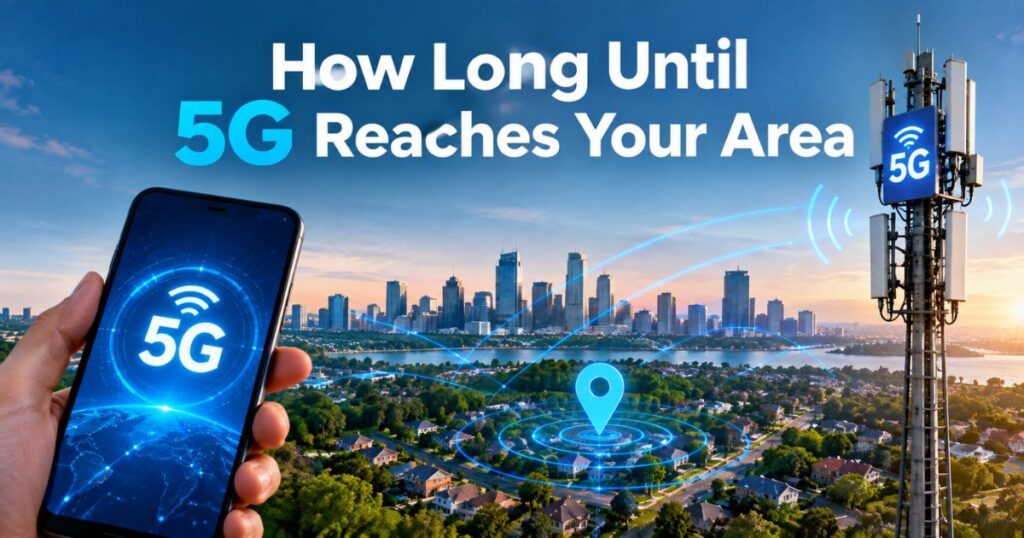
Wondering when 5G will finally reach your street? You are not alone. Millions of people ask the same question before they buy a new phone or a new plan.
The short answer depends on where you live. In big cities, 5G is already live in most countries. In small towns and rural areas, the wait can be anywhere from a few months to several years.
This guide explains the 5G rollout timeline, why some places get service first, and how to check your 5G coverage today.
Quick Answer: How Long Until 5G Reaches You?
Most major cities already have 5G. Suburbs usually follow within one to two years. Rural areas can wait longer because building towers there costs more and fewer people use them.
| Area Type | Typical Wait for 5G | What You Can Expect |
| Large cities | Already available in most markets | Strong mid band and fast speeds |
| Suburbs | 6 months to 2 years | Mix of low band and mid band |
| Small towns | 1 to 3 years | Basic low band coverage first |
| Rural areas | 2 to 5 years, sometimes more | Wider but slower coverage |
These are general estimates. Your carrier and your country can change the timing a lot.
5G Profile Summary Table (2026)
Here is a simple snapshot of where global 5G stands right now.
| Detail | Current Status |
| Global 5G subscriptions | Over 3.1 billion by early 2026 |
| Share of all mobile plans | About one third at the end of 2025 |
| World population covered | Roughly 55% to 60% |
| Commercial 5G networks | Around 360 worldwide |
| Forecast for 2031 | About 6.4 billion 5G subscriptions |
| Main 5G types | Low band, mid band, and mmWave |
| What comes next | 5G Advanced now, 6G later this decade |
The numbers come from the industry reports by Ericsson and the ITU. They show that 5G is growing faster than 4G did at the same stage.
What Does “5G Available” Really Mean?
This is where many people get confused. A 5G icon on your phone does not always mean fast speeds.
There are three main types of 5G, and each one behaves differently.
| 5G Type | Speed | Range | Best For |
| Low band | Slightly faster than 4G | Very wide | Rural and indoor coverage |
| Mid band | Much faster than 4G | Medium | Cities and suburbs |
| High band (mmWave) | Extremely fast | Very short | Stadiums, airports, dense areas |
So when someone says 5G is “available,” ask which type. Mid band 5G gives the real upgrade most people want.
Why Some Areas Get 5G Before Others
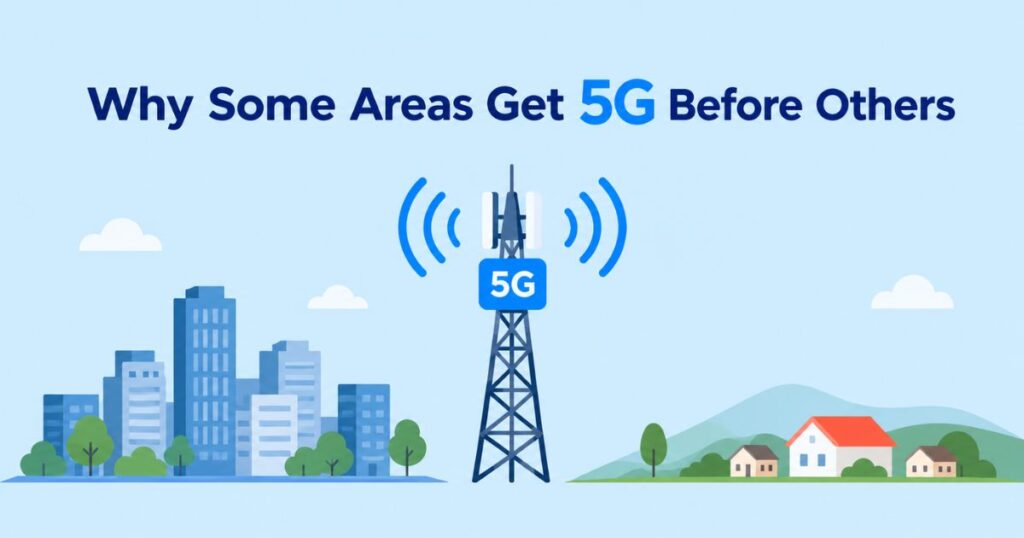
Operators do not roll out 5G everywhere at once. They follow money, demand, and technical limits.
Here are the main reasons your area may be waiting:
- Population density: More users in a small space means a faster return on investment.
- Spectrum licensing: Carriers need government approved airwaves before they can launch.
- Tower and fiber access: Each 5G site needs strong fiber backhaul to carry the data.
- Local permits: Small cell approvals can slow down city projects.
- Equipment supply: Delays in radios and chips can push dates back.
- Device readiness: Carriers prefer to launch where many people already own 5G phones.
In practice, a town with a busy highway or a large employer often gets service sooner than a quiet village nearby.
Also Read This: How Long Until 11:24
The 5G Rollout Process Step by Step
Knowing the stages helps you guess where your area stands.
- Spectrum auction or allocation: The regulator releases airwaves to operators.
- Network planning: Carriers map where to place new sites.
- Tower and fiber upgrades: Crews install new antennas and connect them to fiber.
- Field testing: Engineers check speed, signal strength, and reliability.
- City launch: Service starts in the busiest districts first.
- Expansion: Coverage spreads to suburbs, highways, and smaller towns.
- Standalone upgrade: Operators move to 5G Standalone for better speed and lower delay.
Most regions are now somewhere between steps five and seven.
How to Check If 5G Is Already in Your Area
You may already have 5G and not know it. Try these quick checks.
- Open your carrier coverage map on its official website.
- Enter your home address, not just your city name.
- Look at the map legend to see if the area is low band or mid band.
- Check your phone settings to confirm it supports 5G.
- Walk around outside and test the signal in different spots.
- Run a speed test and compare it with your 4G results.
A useful tip: coverage maps show outdoor signal. Walls, metal roofs, and basements can weaken it indoors.
Why Your Phone Shows 4G Even When 5G Exists
This is a common problem, and it has simple causes.
- Your phone may not support the 5G bands your carrier uses.
- Your SIM or plan may not include 5G access.
- The nearest tower may still run 4G only.
- Your phone may switch to 4G to save battery.
- You may be in a weak spot, such as inside a thick building.
Check your network settings and make sure 5G is switched on. If it still fails, contact your carrier and ask about your plan and device.
What To Do While You Wait for 5G
Do not let a missing signal stop you from upgrading. Here are smart ways to prepare.
- Buy a 5G phone anyway. Almost all mid range and premium phones sold since 2022 support it. The phone falls back to 4G LTE when 5G is missing, so nothing breaks.
- Stay on 4G if it works for you. For video calls, streaming, and maps, 4G is still enough for most people.
- Try fixed wireless internet. Some carriers offer 5G home internet before they offer full mobile coverage.
- Register your interest. Many carriers send an alert when service reaches your address.
- Compare carriers. One provider may reach your area a year before another.
If you plan to keep your phone for three years, a 5G model is a safe choice. Coverage should grow during that time.
5G Advanced and 6G: What Comes After
While rural areas wait for basic 5G, big markets are moving ahead. 5G Advanced is the next upgrade, and it improves speed, battery life, and network efficiency on existing 5G systems.
6G is further away. Standards work is underway, and early launches are expected near the end of this decade in leading markets. You do not need to wait for it. For now, 5G is the network that matters.
Real World Speeds: What Should You Expect?
Speed varies a lot, so set realistic goals.
- Low band 5G: Often feels close to good 4G.
- Mid band 5G: Often delivers several times the speed of 4G.
- mmWave 5G: Can feel almost instant, but only in small zones.
Your results also depend on how many people share the tower at the same time. A busy evening can slow down even a strong signal.
Conclusion
So, how long until 5G is available? For city dwellers, the answer is usually “now.” For suburbs and small towns, expect a wait of one to three years. For remote areas, the timeline can stretch longer, but coverage keeps improving every quarter.
Your best move is simple. Check your carrier map today, choose a 5G ready phone, and sign up for coverage alerts. That way you will be ready the day the signal arrives.
Frequently Asked Questions
When will 5G be available everywhere?
Full coverage may take many years. Experts expect wide rural coverage in the next few years, but some remote places may wait longer.
Do I need a new phone to use 5G?
Yes, you need a phone that supports 5G bands. Most mid range phones released since 2022 already do.
Is 5G faster than 4G in every area?
Not always. Low band 5G can feel similar to 4G, while mid band and mmWave offer a clear speed boost.
Why is my area still waiting for 5G?
Usually it comes down to cost, spectrum, and low demand. Carriers launch first where many people can use the service.
Will a 5G phone work if 5G is not in my area?
Yes. It will connect to 4G LTE automatically and switch to 5G once coverage arrives.